• **Notifications**: Notifications can be dismissed by clicking on the "x" on the righthand side of the notice.
  • **New Style**: You can now change style options. Click on the paintbrush at the bottom of this page.
  • **Donations**: If the Lord leads you please consider helping with monthly costs and up keep on our Forum. Click on the Donate link In the top menu bar. Thanks
  • **New Blog section**: There is now a blog section. Check it out near the Private Debates forum or click on the Blog link in the top menu bar.
  • Welcome Visitors! Join us and be blessed while fellowshipping and celebrating our Glorious Salvation In Christ Jesus.

Kirk Cameron Rejects Eternal Conscious Torment, Embraces Conditional Immortality

I think this is a "false dichotomy" ... was the "burning bush" that Moses encountered "Literal" or "Figurative" ... was it "burning" or "not burning"? (how can you reconcile any answer you give to the burning bush with your statements about the lake of fire?)
My regrets. I didn't see this had been posted.

The reason the fire of the burning bush and the fire of the fiery furnace/lake into which sinners are thrown is not a false dichotomy is because the text of the burning bush explicitly states the bush did not burn up and the fire into which chaff is thrown is explicitly reported to burn up the chaff.

Exodus 3:2
Then the angel of the LORD appeared to him in a blazing fire from the midst of a bush; and he looked, and behold, the bush was burning with fire, yet the bush was not being consumed.

Luke 3:17
His winnowing fork is in his hand to thoroughly clear his threshing floor, and to gather the wheat into his barn; but he will burn up the chaff with unquenchable fire.

Matthew 3:12
His winnowing fork is in his hand, and he will thoroughly clear his threshing floor; and he will gather his wheat into the barn, but he will burn up the chaff with unquenchable fire.”


Comparing the fire of the burning bush with the fire of the chaff-burning fire would be a false comparison, a false equivalence. Observing the fires of judgment do not burn up the chaff is, therefore, not a false dichotomy.
 
No. There is no sin IN the new heavens and earth. There is no death IN the new heaven and earth.
Correct.
Now, OUTSIDE OF the new heaven and earth ... that is another question.
There is nothing OUTSIDE OF the new heavens and earth but God. Only God is uncreated and as you have already posted, the "burn barrel" is created. It is not uncreated. So too is the new creation, the new heavens and earth. It cannot be argued something of the old heavens and earth remains because Revelation explicitly states it passes away. It cannot be said it is a separate creation because there is only one creation, not two or three. The burn barrel is a created part of creation, not something uncreated outside creation (Jn. 1:3) and not another new (third and separate) creation.

There is not "outside of the new heavens and earth." There is no outside apart from God Himself. There is no outside.
 
Correct.

There is nothing OUTSIDE OF the new heavens and earth but God. Only God is uncreated and as you have already posted, the "burn barrel" is created. It is not uncreated. So too is the new creation, the new heavens and earth. It cannot be argued something of the old heavens and earth remains because Revelation explicitly states it passes away. It cannot be said it is a separate creation because there is only one creation, not two or three. The burn barrel is a created part of creation, not something uncreated outside creation (Jn. 1:3) and not another new (third and separate) creation.

There is not "outside of the new heavens and earth." There is no outside apart from God Himself. There is no outside.
What if the statement were worded "something "other than" than the new heaven and new earth instead of "outside of" the new heaven and new earth?

I am not taking a position here as I have not been following the discussion. I am just wondering if the two persons who speak of "outside of" really mean "other than" and if that makes a difference.
 
What if the statement were worded "something "other than" than the new heaven and new earth instead of "outside of" the new heaven and new earth?

I am not taking a position here as I have not been following the discussion. I am just wondering if the two persons who speak of "outside of" really mean "other than" and if that makes a difference.
What is there other than created creation? Or, perhaps, it will help to word the inquiry, "For the created creature, what else is there other than the created creation?"

John 1:3
All things came into being through Him, and apart from Him nothing came into being that has come into being.

Aside from God, there is nothing that was/is not created. The heavens and the earth were created. Hell was created. The fiery lake was/is/will be created. These are all part of creation. To suggest there is something "outside" creation is, therefore, nonsensical. God is the only thing that exists outside creation. Upon what verse of the Bible would we depend on to say the fiery lake is an uncreated place? The minute we say it is a "place" we are asserting something temporal and something geographic about it. Time and space are created parts of creation. If the fiery lake is created, then upon which verse of the Bible would we rely upon to say it is a created place outside the new creation, a created place outside of the new heavens and earth? Upon what verse would rely upon to say it is something other than the new creation?

If the fiery lake is part of the old creation (as is implied by Revelation 20-21) then the fiery lake is done away with. Scripture states the old passes away. The lake itself is annihilated! This is one of the reasons there is no sin, sinners, and death in the new heavens and earth. Everything of the old heavens and earth passes away.

Revelation 21:1-2
Then I saw a new heaven and a new earth; for the first heaven and the first earth passed away, and there is no longer any sea. And I saw the holy city, new Jerusalem, coming down out of heaven from God, made ready as a bride adorned for her husband.

Is the fiery lake "in" or "part of the old heavens and earth? It would seem so, and necessarily so from the vision John is reporting.

Revelation 20:7-15
7
When the thousand years are completed, Satan will be released from his prison, 8and will come out to deceive the nations which are in the four corners of the earth, Gog and Magog, to gather them together for the war; the number of them is like the sand of the seashore. 9And they came up on the broad plain of the earth and surrounded the camp of the saints and the beloved city, and fire came down from heaven and devoured them. 10And the devil who deceived them was thrown into the lake of fire and brimstone, where the beast and the false prophet are also; and they will be tormented day and night forever and ever. 11Then I saw a great white throne and Him who sat upon it, from whose presence earth and heaven fled away, and no place was found for them. 12And I saw the dead, the great and the small, standing before the throne, and books were opened; and another book was opened, which is the book of life; and the dead were judged from the things which were written in the books, according to their deeds. 13And the sea gave up the dead which were in it, and death and Hades gave up the dead which were in them; and they were judged, every one of them according to their deeds. 14Then death and Hades were thrown into the lake of fire. This is the second death, the lake of fire. 15And if anyone’s name was not found written in the book of life, he was thrown into the lake of fire.

The "nations" are in the earth. The throne is in heaven (as is repeatedly reported earlier in Revelation). Sin, sinners, death and Hades are all parts of creation. What is there here, or anywhere else in scripture, to say the fiery lake is something, or some place that is not-created and/or exists outside of creation? If the fiery lake is part of the heavens and the earth then itis intra-creation, not extra-creation. If intra-creational then it passes away in the very next chapter. If it passes away, then what verse would we rely upon to say the lake goes away but everything tossed into the lake remains? If everything tossed into the fiery lake also passes away.....


...then annihilation is the correct understanding of the eternal disposition of the damned.


There is no sin, sinner, death, or Hades in the new heavens and earth because everything in the old heavens and earth has passed away and there is nothing but God outside of, or other than, created creation.
 
Nothing but that which He creates is by definition a created creation.
I expected that response, but hoped for better than semantics conflating a verb with a noun.
(You ignored the question “How high is heaven?” addressing that semantic folly.)

I will waste no more time on THIS conversation.
 
What is there other than created creation? Or, perhaps, it will help to word the inquiry, "For the created creature, what else is there other than the created creation?"
I wasn't suggesting "other than" created creation. Our world is not the only created creation.
 
I expected that response, but hoped for better than semantics conflating a verb with a noun. (You ignored the question “How high is heaven?” addressing that semantic folly.)

I will waste no more time on THIS conversation.
Meh. The red herring and strawmen were and remain irrational foolishness. and deserve to be ignored. They were always going to prove hope unfulfilled. It was delusional to imagine otherwise. Spend time on salient matters and hope is much more likely to be realized.

The fact is everything in Revelation occurs within creation, and that includes sin. Any and all line of inquiry or comment speculating about matters outside of creation are, therefore, off topic. The argument presented, like @JesusFan's many responses, has real and substantive inconsistencies with both scripture and reason and it is those inconsistencies that were ignored. It's hypocrisy to say, "You ignored!" while ignoring the real problem (the fact sin no longer exists in the the new heavens and earth, but ECT has no explanation for how eternal conscious torment can exist in a sinless creation.

Sin is abolished in the new heavens and earth. It is annihilated, eradicated to the point it no longer exists. Sin is abolished both behaviorally and dispositionally. There is no breaking of God's commands, precepts or laws. There are no lusts that entice and drag the creature into sin and death. ECT arguments for the existence of hell invariably ignore the fact hell is thrown into the fiery lake. Hell is not the final destination, nor the final disposition. The fiery lake is what happens in the end. Hell, death, and all the sinners denying Jesus are thrown into the fiery lake. The fire of judgment consumes that which is thrown into it. The one with the power to destroy both body and soul destroys body and soul to the point neither exists any longer. The few verses that allude to something unending are idioms, figures of speech that never define the literal. All of them exist as minority of the figurative references, and they can all be understood to describe the magnitude, not the nature, of the rotting destruction that is the final judgment. In any normal and ordinary understanding of fire, it destroys that which is subjected to the fire. Whether it takes a lengthy amount of time or not, the end is the cessation of existence. That which was is gone. At best there remains only ash but in the hottest of fires not even ash remains. If this is not the case, then the only alternative is that sin and death persist in the new heavens and earth and all of the scripture describing the final disposition contradict themselves. Nothing is actually purified, sin and imperfection persist, death still exists, and all of us can go over to the fiery lake and observe the corrupt spot in the new heavens and earth where sin and death are confined anytime we so choose.

Every single point of ECT dissent has been addressed and the responses proved impoverished and ineffective.
 
I wasn't suggesting "other than" created creation.
Then clarify it for me. What was being suggested?
Our world is not the only created creation.
"Our world" is not the topic of discussion, nor is it germane to the discussion. Depending on what is intended by "our word," the fact of scripture is this world will pass away. The discussion about sin's persistence is couched in the heavens and the earth, creation as a whole, not merely "our world." I just surveyed the entire thread and except for Post 65, which corrects the premise the world will end when it is the age that was going to end, Post 166 is the first and only post to mention the word "world," as in "our world."

I would ask, "What other heavens and earth are there in scripture?" but everything in in the Bible is about the heavens and the earth of Genesis 1:1, and that includes everything written in Revelation until chapters 21-22. The op is about Kirk Cameron's move from ECT to annihilationism and the veracity of annihilationism relevant to whole scripture. Everything scripture has to say about the final disposition of sinners is couched in the heavens and earth created that were created at Genesis 1:1. The judgment awaiting each and every person occurs on the other side of the grave, not here on earth, or in our world.

1 Corinthians 5:9-10
I wrote to you in my letter not to associate with sexually immoral people; I did not at all mean with the sexually immoral people of this world, or with the greedy and swindlers, or with idolaters, for then you would have to leave the world.

LOL. We have to leave our world to get away from sin ;). Blessedly God has destined every individual to die once and face judgment, and that happens on the other side of the grave, nor here in our world. Those who have been dragged to Christ by grace through faith for salvation from sin and the wrath of God commensurate to sin receive eternal life. They are raised from the grave incorruptible and immortal into eternal life. That's not this world. That's not "our" would. Those who deny Christ, those who sow to the flesh, receive and entirely different outcome. What they reap is corruption and destruction. That happens in a fiery lake so lethal even death is destroyed. I know of no such lake in our world today if "our world" is intended to mean the planet earth and/or the way it currently functions. That lake also exists on the other side of the grave, according to Rev. 20. Neither outcome is part of "our world" if the phrase is intended to mean what we currently observe and experience on earth and the world where sin still exists.

The question, "Does sin exist in the new heavens and earth?" was designed to draw attention to the inconsistency in ECT. If the new heavens and earth is sinless, or sin-free, then there cannot be a fiery lake where sinners still live. Multiple posts, like posts 145 and 154 asserted those in the fiery lake are still living. Sin and sinners still live in the new heavens and earth, according to ECT. That's a problem. It's hugely inconsistent for an ECTer to say heaven and earth will one day be made anew and sin and death will no longer exist while also saying hell is eternal and everyone living in the fiery lake will continue living for all eternity. To rhetorically borrow a line from Hal Lindsay, Sin is alive and well in the new creation! 🤮

That inconsistency is the point of the inquiry.

That question was asked more than thirty posts ago and no one has resolved the very real inconsistency in the ECT case. If there's no sin or death in the new heavens and earth, then ECT cannot be true. Annihilationism solves that problem, and it solves that problem firmly relying on scripture read exactly as written. The fire of judgment consumes what is thrown into it. However long the rotting decay of corruption may take, rot and decay eventually end with the eradication of whatever was rotting away. The one who has the power to destroy both body and soul in hell does exactly that; He destroys. Hell isn't the final disposition. Hell itself, along with death, is thrown into a fiery lake. It's the fiery lake, not hell, that is the final destination for all Christ-denying sinners and scripture tells us death is eventually abolished (Gk.: katargeo = cease to exist, destroyed, done away, vanishing away, made void). Death is thrown into the fiery lake and no longer exists. The first heaven and the first earth pass away. They no longer exist as they did when sin, sinners, and death persisted. a new heavens and earth are seen.

Does sin and death exist in the new heavens and earth?

No. It has all been eradicated. It has all been annihilated. There's no place in the new heavens and earth where the incorruptible immortal who've received eternal life can go see still-living sinners writhing around with death in the new heavens and earth. If that were the case the new heavens and earth would not be sinless. Sin, sinners, and death would merely be controlled and contained, not apolesai or katargeo.

There wasn't any sin in the first heavens and earth until the corruptible and mortal Adam and Eve brought it into the world through their disobedience. One the other side of the grave those in Christ will be raised incorruptible and immortal and those outside of Christ will be raised to incur the second death so violently lethal that even hell and death are burned up and wholly consumed.

No more sin. No more sinners. No more hell. No more death. 😇
 
Then clarify it for me. What was being suggested?
I wasn't suggesting anything.
What if the statement were worded "something "other than" than the new heaven and new earth instead of "outside of" the new heaven and new earth?

I am not taking a position here as I have not been following the discussion. I am just wondering if the two persons who speak of "outside of" really mean "other than" and if that makes a difference.
Post 163.
 
Matthew 25:31-34, 41, 46 [NASB]
31 "But when the Son of Man comes in His glory, and all the angels with Him, then He will sit on His glorious throne. 32 "And all the nations will be gathered before Him; and He will separate them from one another, just as the shepherd separates the sheep from the goats; 33 and He will put the sheep on His right, but the goats on the left. 34 "Then the King will say to those on His right, 'Come, you who are blessed of My Father, inherit the kingdom prepared for you from the foundation of the world. ... 41 "Then He will also say to those on His left, 'Depart from Me, you accursed people, into the eternal fire which has been prepared for the devil and his angels; ... 46 "These will go away into eternal punishment, but the righteous into eternal life."

From the lips of Jesus.
“Eternal” means eternal.
“Annihilation” is not “eternal punishment”.

Luke 16:22-24 [NASB]

22 "Now it happened that the poor man died and was carried away by the angels to Abraham's arms; and the rich man also died and was buried. 23 "And in Hades he raised his eyes, being in torment, and saw Abraham far away and Lazarus in his arms. 24 "And he cried out and said, 'Father Abraham, have mercy on me and send Lazarus, so that he may dip the tip of his finger in water and cool off my tongue, for I am in agony in this flame.'

From the lips of Jesus.
“torment” means torment and “flame” means flame.
“Conscious torment” is what Jesus described when he had the opportunity to speak the truth.
 
“Annihilation” is not “eternal punishment”.
Sure it is. That case has already been presented by multiple posters, and the dissent has not addressed that argument. Nothing is more permanent then the cessation of existence. Once gone always gone. That punishment is eternal. The ECT interprets that verse to say the torture and suffering are eternal but that is not what the verse can be made to say once all what scripture has to say on the subject is considered. Chaff thrown into a fire is burned up. It is destroyed, according to the Greek. The punishment of destruction is eternal. Matthew 25:46 cannot be pitted against Luke 3:16 in contradiction. All Post 170 accomplishes is to present an inconsistency in the way ECT renders whole scripture. Until that inconsistency is resolved ECT has a problem.
“Conscious torment” is what Jesus described when he had the opportunity to speak the truth.
Scripture, again, proves otherwise. Eternal conscious torment creates a new heavens and earth where sin, sinners, hell, and death still exist because conscious torment is purportedly eternal. That new heavens and earth are an improvement upon the old only to the degree sin and death are controlled and localized. ECT is not and can never be a restoration of creation in which sin is entirely absent.
 
Sure it is. That case has already been presented by multiple posters, and the dissent has not addressed that argument. Nothing is more permanent then the cessation of existence. Once gone always gone. That punishment is eternal. The ECT interprets that verse to say the torture and suffering are eternal but that is not what the verse can be made to say once all what scripture has to say on the subject is considered. Chaff thrown into a fire is burned up. It is destroyed, according to the Greek. The punishment of destruction is eternal. Matthew 25:46 cannot be pitted against Luke 3:16 in contradiction. All Post 170 accomplishes is to present an inconsistency in the way ECT renders whole scripture. Until that inconsistency is resolved ECT has a problem.

Scripture, again, proves otherwise. Eternal conscious torment creates a new heavens and earth where sin, sinners, hell, and death still exist because conscious torment is purportedly eternal. That new heavens and earth are an improvement upon the old only to the degree sin and death are controlled and localized. ECT is not and can never be a restoration of creation in which sin is entirely absent.
Genesis 1 describes “creation”.
Where in creation is “HEAVEN” located?
Where in creation is “SHEOL” located?

Can we build a tower to “Heaven” or dig a tunnel to “Sheol”?
 
Genesis 1 describes “creation”.
Where in creation is “HEAVEN” located?
Where in creation is “SHEOL” located?
In the heavens and the earth. It is all part of creation and I posted some of the verses that state that fact. Acting like these questions haven't already been answered is the problem to be solved, not something that brings any veracity to ECT.
Can we build a tower to “Heaven” or dig a tunnel to “Sheol”?
Relevance?

The fact is any tower that could be built and any tunnel that could be dug would both be within creation. All that has been made, whether visible or invisible has been made by God, the Creator. That includes Satan, death, and the fiery lake. You can ask all those already-answered questions again and again, but they will never resolve the inconsistency within ECT's claim the punishment is eternal, sinners, Satan, and hell will exist eternally and there is no sin and death in new heavens and earth. It is a self-contradictory, self-refuting, irrational set of beliefs and even if annihilationism was disproved that would not make ECT correct.
 
Creation (noun)
  • “the bringing into of existence of the universe, especially when regarded as an act of God.” - Cambridge Dictionary
  • “the act of bringing the world into ordered existence” - Merriam-Webster Dictionary

FYI: Heaven and Hell are not part of “creation” (noun) even if they were “created” (verb) by God.
  • Q. Where in creation is “HEAVEN” located?
  • Q. Where in creation is “SHEOL” located?
  • A. “In the heavens and the earth.”
Incorrect answer. Creation is the “universe” or the “world”, the physical and not the metaphysical. That is what the questions were intended to draw your attention to.

  • Q. Can we build a tower to “Heaven” or dig a tunnel to “Sheol”?
  • A. “Relevance? The fact is any tower that could be built and any tunnel that could be dug would both be within creation.”
The “relevance” is that it is impossible to build a physical connection to a metaphysical place. No rocket will ever fly to heaven. No tunnel will ever dig to hell. The Spirit is not part of the physical world. It cannot be empirically measured or controlled.

Your arguments conflate the two and insist that physical creation (the world and universe) is inseparable from the spiritual realm (heaven and hell).

You can ask all those already-answered questions again and again, but they will never resolve the inconsistency within ECT's claim the punishment is eternal, sinners, Satan, and hell will exist eternally and there is no sin and death in new heavens and earth.
That is exactly the point that I have been addressing. The only inconsistency is your placing Heaven and Hell inside of “creation” (world/universe) and refusing to see that if God can now create three distinct places (Heaven, Earth, Hades) then God has the power to create two new distinct separate places (“New Heaven and Earth” and “Lake of Fire”) as future places of eternal destiny. There will be no sin or death in the “New Heaven and Earth” place. There will be both sin and the second death in the “Lake of Fire” place.
 
Heaven and Hell are not part of “creation” (noun) even if they were “created” (verb) by God.
Scripture says otherwise.

Genesis 1:1
In the beginning God created the heavens and the earth.

Exodus 20:11
For in six days the LORD made the heavens and the earth and the sea and all that is in them...

Nehemiah 9:6
You alone are the LORD. You created the heavens, the highest heavens with all their host, the earth and all that is on it...

Psalm 33:6
By the word of the LORD the heavens were made, and all the stars by the breath of His mouth.
Psalm 148:1-5
1
Praise the LORD! Praise the LORD from the heavens; Praise Him in the heights! 2Praise Him, all His angels; Praise Him, all His heavenly armies! 3Praise Him, sun and moon; Praise Him, all stars of light! 4Praise Him, highest heavens, and the waters that are above the heavens! 5They are to praise the name of the LORD, for He commanded and they were created.

Isaiah 45:12
It is I who made the earth and created man upon it. It was My hands that stretched out the heavens, and I ordained all their host.

John 1:3
Through him all things were made; without him nothing was made that has been made.

1 Corinthians 8:5-6
For even if there are so-called gods whether in heaven or on earth, as indeed there are many gods and many lords, yet for us there is only one God, the Father, from whom are all things, and we exist for Him; and one Lord, Jesus Christ, by whom are all things, and we exist through him.

Colossians 1:16
For by Him [Jesus] all things were created, both in the heavens and on earth, visible and invisible, whether thrones or dominions or rulers or authorities — all things have been created through him and for him.

Hebrews 11:3
By faith we understand that the world has been created by the word of God so that what is seen has not been made out of things that are visible.

2 Peter 3:3-5
Know this first of all, that in the last days mockers will come with their mocking, following after their own lusts, and saying, “Where is the promise of His coming? For ever since the fathers fell asleep, all things continue just as they were from the beginning of creation.” For when they maintain this, it escapes their notice that by the word of God the heavens existed long ago and the earth was formed out of water...

Revelation 4:11
Worthy are you, our Lord and God, to receive glory and honor and power, for you created all things, and by your will they existed and were created.

All things are created. Creation is created. That which God created is creation. The creation of creation includes the heavens and the earth and all that has been made (which would include hell and the fiery lake).
The only inconsistency is your placing Heaven and Hell inside of “creation” (world/universe) and refusing to see that if God can now create three distinct places (Heaven, Earth, Hades) then God has the power to create two new distinct separate places (“New Heaven and Earth” and “Lake of Fire”) as future places of eternal destiny.
The "three distinct places" are constituent places of creation. There are not three creations in scripture. Neither are there four, five, or six different creations. The word "creation" is not synonymous with the word "world." There is not a single verse that states what Post #174 states but there are multiple verses stating everything was made by God. The entire argument Post 174 summarizes is built on a construction error assuming facts not in evidence (there are multiple creations, the creation of multiple creations, the creation of places outside of creation/the universe).
Creation is the “universe” or the “world”, the physical and not the metaphysical.
That is incorrect. Secularists may believe the universe is only that which is physical but that is not what scripture teaches.

Hebrews 11:3
By faith we understand that the universe was created by the word of God, so that what is seen was not made out of things that are visible.

The Greek word there translated as "universe" is "aionas," which means ages of ages, eternal, or forever. The verse states forever was created by God. Forever is metaphysical, not physical, and I do not think you're using the word "metaphysical" correctly. That word means "abstract concepts such as being, knowing, substance, cause, identity, time, and space," or "the fundamental nature of reality, existence, and being," all of which God created. The word also means "abstract theory with no basis in reality." so if what Post #174 is arguing is that which has no basis in reality the post is a self-evident nonsensical fail.

In the argument culminating in Post 174....

  1. Factual errors are asserted as facts.
  2. There's no scripture stating what has been posted.
  3. Invented terms and definitions are being used.
  4. Facts not in evidence are being asserted as givens.
  5. A false dichotomy in which the physical and non-physical are assumed to be separate is asserted.
  6. A composition fallacy in which separate places cannot be parts of a whole is asserted.
It is factually incorrect, exegetically void, and logically irrational.

Btw, heaven is not a metaphysical place, and the phrase "metaphysical place" is a contradiction in terms. A tower could be built to heaven, but it would not be a tower of earthly materials. Likewise, not only can a "tunnel" be built to reach Sheol, but such a thing already exists and every single human who has ever lived will use it. It's just not a tunnel dug into the earth as the sophistry of those two inquires assumes.

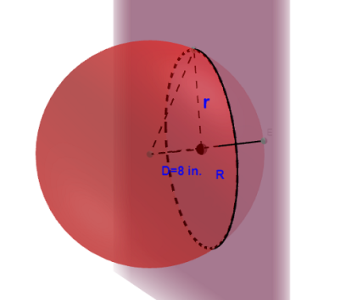
Were we to use the schema you've asserted the better, accurate, way to understand it would be something like a sphere intersecting a plane.

sphere and plane.png

Except the sphere surrounds the plane rather than the plane extending beyond the boundaries of the sphere. At the points where the intersection occurs the creatures living in the two-dimensional plane see a circle. That's all they see. That is all they experience. It does not matter whether the circle is physical, metaphysical, extra-physical, etc. No matter what constitutes the sphere, all the plane people know is that flat section where the intersection occurs. The creatures of sphere can see all of the plane as well as that which is in the sphere. There is no "up" or "down," no view of any other space for the two-dimensional creatures, whereas those living in the three-dimensional space can see "up," "down," "left", "right," north, south, east, west, and every which way more then the 2-D creature.

Now make the illustration a ten- or eleven-dimensional object intersecting and encompassing a four-dimensional one. That would be the correct way to describe the universe that God has created.

Two more things:

  1. God exists external to both objects. He can enter and exist and act within and upon both objects but He Himself is neither. He created both objects as parts of a whole. The Bible calls it creation. Secularists call it the universe (or multiverse).
  2. If by "metaphysical," you mean "spiritual," then that is another false dichotomy because spirits have mass. When angels appear on earth, they are visible. That means they have mass sufficient to reflect light. When scripture states something is "invisible" that does not mean it does not have mass or matter, but that it is not visible by us earthly or two-dimensional people. God sees all of them all the time.

Post #174 was a waste of the time and effort it took to write it. Everything that exists was made by God. Everything includes hell and the fiery lake.
.
 
What if the statement were worded something "other than" than the new heaven and new earth, instead of "outside of" the new heaven and new earth?

I am not taking a position here as I have not been following the discussion. I am just wondering if the two persons who speak of "outside of" really mean "other than" and if that makes a difference.

That wouldn’t help because “the heavens and the earth” is a merism, a figure of speech in which two contrasting parts are used to express the totality of everything God created. In the same way, “new heavens and new earth” in ordinary biblical usage functions as a merism for the totality of the renewed creation.

This is not a reference to two locations, thus allowing an “outside of” or “other than.” With respect to the Creator–creature distinction, there is no tertium quid, whether “outside of” or “other than.” There is the Creator and his creation. That is it.
 
“Annihilation” is not “eternal punishment.”

Yes, it is. No one comes back from that. It is forever.

I will agree, however, that annihilation is not “eternal punishing.”

Luke 16:22-24 – Now it happened that the poor man died and was carried away by the angels to Abraham's arms; and the rich man also died and was buried. And in Hades he raised his eyes, being in torment, and saw Abraham far away and Lazarus in his arms. And he cried out and said, "Father Abraham, have mercy on me and send Lazarus, so that he may dip the tip of his finger in water and cool off my tongue, for I am in agony in this flame."​

… Conscious “torment” is what Jesus described when he had the opportunity to speak the truth.

The topic is annihilation, which pertains to the final state; this parable in Luke refers to the intermediate state. Moreover, the wicked are annihilated in gehenna; this parable in Luke refers to hades.
 
Moreover, the wicked are annihilated in gehenna; this parable in Luke refers to hades.
Are dead Jews really punished in the Greek underworld now, and in the Trash Fires outside first century Jerusalem in eternity? I think not. (Two linguistic metaphors for the same metaphysical reality).
 
Are dead Jews really punished in the Greek underworld now, and in the Trash Fires outside first century Jerusalem in eternity? I think not. (Two linguistic metaphors for the same metaphysical reality).

You are asserting an equivalence where none has been demonstrated. Obviously these terms are figurative. The question is whether they are exegetically coextensive in referent. If your argument assumes that Scripture uses hades and gehenna interchangeably—two linguistic figures for the same eschatological reality—then that premise must be established from the text. Otherwise the argument simply begs the question. Show by exegesis of the relevant passages that these terms function interchangeably in their redemptive-historical contexts. It is not enough merely to observe that both are metaphorical. Until that case is made, appealing to Luke 16 against annihilationism is methodologically defective, because it imports into a text about hades conclusions about gehenna and the final state that the text itself does not establish.
 
Are dead Jews really punished in the Greek underworld now, and in the Trash Fires outside first century Jerusalem in eternity? I think not. (Two linguistic metaphors for the same metaphysical reality).
You are asserting an equivalence where none has been demonstrated. Obviously these terms are figurative. The question is whether they are exegetically coextensive in referent. If your argument assumes that Scripture uses hades and gehenna interchangeably—two linguistic figures for the same eschatological reality—then that premise must be established from the text. Otherwise the argument simply begs the question. Show by exegesis of the relevant passages that these terms function interchangeably in their redemptive-historical contexts. It is not enough merely to observe that both are metaphorical. Until that case is made, appealing to Luke 16 against annihilationism is methodologically defective, because it imports into a text about hades conclusions about gehenna and the final state that the text itself does not establish.
and the question has already been answered and answered diversely (HERE, HERE, HERE, and HERE).

Post #9 (the premise there are two completely different and entirely separate creations) deserves it's own op. The assertion and defense of that position is hijacking this op. The premise there is an eternal creation is oxymoronic because if something is created then it is not eternal. It might be everlasting but it's not eternal. However, this thread is not the place to discuss it. Until that digression is addressed and decided everyone is talking past one another because we're not talking about the same creation.
 
Back
Top