
Ben Avraham
Freshman
- Joined
- Jul 20, 2023
- Messages
- 91
- Reaction score
- 35
- Points
- 18
PARASHA: “Vayikra” (and he called) LEVITICUS 1:1-5:26
The word “VaYikra” (in the original Hebrew) is interesting, as it occurs 3 times. It means “called to (and a person’s name) In other words, Adonai called Moses from where “he was” to where “Adonai is,” to “bridge the gap of distance.”
The first “VaYikra” was when Moshe was in the desert attending Yitro’s flock of sheep. Moshe sees the “burning bush,” and then, Adonai calls to” Moshe to come closer”, thus bridging the gap of distance.
The second time it occurs is when Adonai “calls to” Moshe to go up Mt. Sinai, to receive the Torah commandments, and then, to teach those to HIS people.
This is the third time, at the beginning of Leviticus, the Mishkan (Tabernacle) is finished, and the glory cloud rests on it, and then, Adonai “calls to” Moses, to “come near”. The tabernacle has been built according to Adonai’s instructions; it is HIS home, and now, He invites Moshe and the priests into HIS home.
Today, Adonai “calls all of us” to come near his glory, through our relationship with Messiah Yeshua, who bridges that “gap” of distance, through his own blood. He is the “Korban” (offering) that brings us near; we are sinful, and He is holy. We responded to His call, because He calls us by name!
We begin the book of Leviticus with the sacrificial system in the Tabernacle. , now ready to be used. This sacrificial system will be instituted within the Mishkan. All the sacrifices point to and illustrate MESIAH YESHUA (Jesus the Christ), who he is and what his one-time sacrifice means to us as believers. Even though the sacrificial system was completed and fulfilled with Messiahs’ death on Calvary, it is still worthwhile studying the meaning of it all, since it is a very integral part of the Bible.
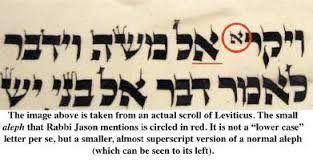
One interesting part of the word “Vayikra” is that in Hebrew, there is a small “Aleph” (the very first letter of the Hebrew alphabet) at the end of the word. Some ask as to why? Why is the “Aleph” small and a bit elevated? One answer is that it reminds us to approach God humbly; we must humble ourselves when we look up to HIM. The other answer is that Adonai “humbled” Himself when He came to earth as man, in the form of Yeshua, exposing Himself to heat, cold, happiness, sadness, getting tired, and finally, feeling the pain of the nails and the whips, all for our sakes.
The letter “Alef” is really made up of one “Vav” and two “yods,” one on one side of the “Vav” and the other on the other side, one on top and one on the bottom. One can see the symbolism, two “hands” and the “nail”. Two “Yods” and one “Vav” sum “26”, and also the sacred name YHVH also sums “26” in gematria.
The first thing you must do is read over the scripture verses, from Chapter 1:1 through 5:26. Now we are ready for a discussion. The whole idea of a “Korban” (offering) is to generate the idea of “substitution”. Also, the word “Korban” symbolizes “coming close to God.” Our sin separates us from God, yet through the blood, in our case, the blood of Yeshua, we come “close” to God.
The sacrificial system involves: a gift, a death, a substitute, and a renewed “close” relationship. “The gift comes from the person offering, which is an animal. The animal, which would be a goat, a lamb, a bull, or a bird, would be killed and the blood splattered on the altar; the animal would be a “substitute” for the person who offers it. The sins of the person “transfer” to the animal. Through the sacrifice, the relationship between the offeror and YHVH is renewed. But remember that the “sacrifices” are just symbolic of what they really mean, which is Messiah Yeshua taking on ALL of our sins and being nailed to the cross, and shedding his blood for our sins, giving us a “renewed” relationship with Him, through a “born-again” experience.
There were 5 kinds of “korbanot” (offerings): 1. The burnt offering (Olah), 2. The sin offering (chatat), 3. The guilt or trespass offering (Asham); 4. The Peace offering ( Shelamim) 5. The grain or meat offering (Minchah). Each one identifies our relationship with Messiah Yeshua.
THE BURNT OFFERING (Olah) This involved an animal sacrifice; the animal was completely burned on the altar, and the ashes taken away and buried “outside the camp.” The head, the inner organs, and the legs were burned as well. The pieces of the animal were arranged on the altar and burned. The head could symbolize our “thoughts,” the inner organs could represent our “inner being, the heart, and the legs, our “walk,” all of these were “offered up” to YHVH, thus symbolizing our “complete surrender to God in all that we are and have. The altar, as you remember, was made of hardwood overlaid with bronze and had a grill in the middle, and under the grill was earth and stones.
Wood was laid on the grill, and the animals were cut up and laid on the grill and burned. This reminds us of Yeshua, who was “sacrificed” by his own free will on a WOODEN cross and was consumed by the “fires of judgment.” He was judged for OUR SINS. The animal’s throat was cut, and the blood was poured out and splashed on the altar. The person offering the animal showed that he/his family was “offering themselves to the LORD”. It also symbolizes our awareness of our sinful nature. This sacrifice originated in Genesis, with Adam and Eve, Abel offered an “Olah Korban”, so did Abraham, when he offered up the ram instead of his son Isaac, so did Noah, when he left the ark.
THE SIN OFFERING (korban chatat) This also involved an animal sacrifice. It symbolized our specific sins that we commit by mistake (active) or something we do not do, or forget to do (passive). In this korban, the person would offer the animal as a sacrifice, and the person would place his hands on the head of the animal, transferring his “sins” into the animal, which would be the “substitute. The animal’s throat would be cut, and the blood splattered on the altar. The priest would offer on the altar the fat, the liver, and the kidneys of the animal. These could symbolize our inner being. In this, the person confessed their sins, and they did it by free will, and the animal symbolized Yeshua, who paid our sin price in full.
It is also interesting to know that there was no offering for an "intentional sin" or "sinning on purpose" or "rebellion." The answer to that was the curse, punishment, being "cut off." That is why the sacrifice of Yeshua/Jesus was a "Better covenant" than the first, as it covered both "unintentional and intentional" sins.
THE TRESPASS OR GUILT OFFERING; This involved the same process, only that the person who committed an offense against another would also have to bring compensation for the wrongdoing, either in payment in silver or gold, or payment with animals. When we offend another person, whether the person is a brother or sister in Messiah or an unbeliever, we need to “compensate” the sin; if we can do it, sometimes we cannot; if the sin is against the person’s character, no amount of money can repay the damage done, only a sincere confession in humbleness. So, we need to watch our “walk”.
THE PEACE OFFERING (Shelamim). The word “Shelamim” comes from “Shalom” (peace). This was an enjoyable sacrifice in which both the priest and the offeror and his family would enjoy “roast beef, goat, or lamb.” This was an offering of "Thankfulness" for blessings received. The animal was offered in the same way, only the meat was shared between the priest and his family, and the offeror and his family. We see this kind of “korban” even today in the parks, when families go out and BBQ meat, many times they invite friends and family to enjoy in the “grilling and BBQ” they also have bread, or tostadas, tortillas, drinks, salad, etc. to accompany the meal.
THE MEAL OR MEAT OFFERING (Minchah). This was a non-blood offering on the altar. In this korban, fine flour was offered, mixed with olive oil, frankincense, and also, the flour was made into cakes, rolls of bread, or flat breads (tortillas), but made without leaven or honey. These usually accompanied the peace offerings, to make the meal a “feast”. The fine flour symbolizes “YESHUA THE BREAD OF LIFE,” the oil THE RUACH HA KODESH (The holy Spirit), the frankincense, OUR FELLOWSHIP THROUGH PRAYER. The animal itself represented Yeshua, who gave his life for us, and took upon himself ALL of our sins, past, present, and future. The word “KORBAN” (sacrifice) comes from the Hebrew verb KARAV, which means “to come near.”
We can only come near to YHVH through the shed blood of Messiah Yeshua, who was the “sacrificed lamb” the Bible says that “without the shedding of blood, there can be no remission of sins” Our sins were “atoned for once and forever. That is why the “new covenant” or “renewed” covenant is a BETTER covenant, because there is no more need for animal sacrifices, because YESHUA took their place.
Salt was also included in the offerings, being a "Brit Melach," A covenant of salt. Matt 5:13 says that we should be the "Salt of the Earth. Salt has both destructive properties and preserving properties (according to Rambam). May our sin nature and carnal self be destroyed, and our Spiritual walk with Yeshua be preserved.
Jesus was our sacrifice of sin. It was the "Father's" gift to all of us, His only son who carried our sin and guilt in our place, so that through the sacrifice of Yeshua, we might come close to God. He was that "bridge" that crossed the "valley of sin" that "bridge over" the barrier to a renewed relationship with the Father. Yet many reject that, sadly, let us not reject that gift of salvation, the gift of "Yeshuah." God is still calling...even today...even YOU. Will you answer?

The word “VaYikra” (in the original Hebrew) is interesting, as it occurs 3 times. It means “called to (and a person’s name) In other words, Adonai called Moses from where “he was” to where “Adonai is,” to “bridge the gap of distance.”
The first “VaYikra” was when Moshe was in the desert attending Yitro’s flock of sheep. Moshe sees the “burning bush,” and then, Adonai calls to” Moshe to come closer”, thus bridging the gap of distance.
The second time it occurs is when Adonai “calls to” Moshe to go up Mt. Sinai, to receive the Torah commandments, and then, to teach those to HIS people.
This is the third time, at the beginning of Leviticus, the Mishkan (Tabernacle) is finished, and the glory cloud rests on it, and then, Adonai “calls to” Moses, to “come near”. The tabernacle has been built according to Adonai’s instructions; it is HIS home, and now, He invites Moshe and the priests into HIS home.
Today, Adonai “calls all of us” to come near his glory, through our relationship with Messiah Yeshua, who bridges that “gap” of distance, through his own blood. He is the “Korban” (offering) that brings us near; we are sinful, and He is holy. We responded to His call, because He calls us by name!
We begin the book of Leviticus with the sacrificial system in the Tabernacle. , now ready to be used. This sacrificial system will be instituted within the Mishkan. All the sacrifices point to and illustrate MESIAH YESHUA (Jesus the Christ), who he is and what his one-time sacrifice means to us as believers. Even though the sacrificial system was completed and fulfilled with Messiahs’ death on Calvary, it is still worthwhile studying the meaning of it all, since it is a very integral part of the Bible.
One interesting part of the word “Vayikra” is that in Hebrew, there is a small “Aleph” (the very first letter of the Hebrew alphabet) at the end of the word. Some ask as to why? Why is the “Aleph” small and a bit elevated? One answer is that it reminds us to approach God humbly; we must humble ourselves when we look up to HIM. The other answer is that Adonai “humbled” Himself when He came to earth as man, in the form of Yeshua, exposing Himself to heat, cold, happiness, sadness, getting tired, and finally, feeling the pain of the nails and the whips, all for our sakes.
The letter “Alef” is really made up of one “Vav” and two “yods,” one on one side of the “Vav” and the other on the other side, one on top and one on the bottom. One can see the symbolism, two “hands” and the “nail”. Two “Yods” and one “Vav” sum “26”, and also the sacred name YHVH also sums “26” in gematria.
The first thing you must do is read over the scripture verses, from Chapter 1:1 through 5:26. Now we are ready for a discussion. The whole idea of a “Korban” (offering) is to generate the idea of “substitution”. Also, the word “Korban” symbolizes “coming close to God.” Our sin separates us from God, yet through the blood, in our case, the blood of Yeshua, we come “close” to God.
The sacrificial system involves: a gift, a death, a substitute, and a renewed “close” relationship. “The gift comes from the person offering, which is an animal. The animal, which would be a goat, a lamb, a bull, or a bird, would be killed and the blood splattered on the altar; the animal would be a “substitute” for the person who offers it. The sins of the person “transfer” to the animal. Through the sacrifice, the relationship between the offeror and YHVH is renewed. But remember that the “sacrifices” are just symbolic of what they really mean, which is Messiah Yeshua taking on ALL of our sins and being nailed to the cross, and shedding his blood for our sins, giving us a “renewed” relationship with Him, through a “born-again” experience.
There were 5 kinds of “korbanot” (offerings): 1. The burnt offering (Olah), 2. The sin offering (chatat), 3. The guilt or trespass offering (Asham); 4. The Peace offering ( Shelamim) 5. The grain or meat offering (Minchah). Each one identifies our relationship with Messiah Yeshua.
THE BURNT OFFERING (Olah) This involved an animal sacrifice; the animal was completely burned on the altar, and the ashes taken away and buried “outside the camp.” The head, the inner organs, and the legs were burned as well. The pieces of the animal were arranged on the altar and burned. The head could symbolize our “thoughts,” the inner organs could represent our “inner being, the heart, and the legs, our “walk,” all of these were “offered up” to YHVH, thus symbolizing our “complete surrender to God in all that we are and have. The altar, as you remember, was made of hardwood overlaid with bronze and had a grill in the middle, and under the grill was earth and stones.
Wood was laid on the grill, and the animals were cut up and laid on the grill and burned. This reminds us of Yeshua, who was “sacrificed” by his own free will on a WOODEN cross and was consumed by the “fires of judgment.” He was judged for OUR SINS. The animal’s throat was cut, and the blood was poured out and splashed on the altar. The person offering the animal showed that he/his family was “offering themselves to the LORD”. It also symbolizes our awareness of our sinful nature. This sacrifice originated in Genesis, with Adam and Eve, Abel offered an “Olah Korban”, so did Abraham, when he offered up the ram instead of his son Isaac, so did Noah, when he left the ark.
THE SIN OFFERING (korban chatat) This also involved an animal sacrifice. It symbolized our specific sins that we commit by mistake (active) or something we do not do, or forget to do (passive). In this korban, the person would offer the animal as a sacrifice, and the person would place his hands on the head of the animal, transferring his “sins” into the animal, which would be the “substitute. The animal’s throat would be cut, and the blood splattered on the altar. The priest would offer on the altar the fat, the liver, and the kidneys of the animal. These could symbolize our inner being. In this, the person confessed their sins, and they did it by free will, and the animal symbolized Yeshua, who paid our sin price in full.
It is also interesting to know that there was no offering for an "intentional sin" or "sinning on purpose" or "rebellion." The answer to that was the curse, punishment, being "cut off." That is why the sacrifice of Yeshua/Jesus was a "Better covenant" than the first, as it covered both "unintentional and intentional" sins.
THE TRESPASS OR GUILT OFFERING; This involved the same process, only that the person who committed an offense against another would also have to bring compensation for the wrongdoing, either in payment in silver or gold, or payment with animals. When we offend another person, whether the person is a brother or sister in Messiah or an unbeliever, we need to “compensate” the sin; if we can do it, sometimes we cannot; if the sin is against the person’s character, no amount of money can repay the damage done, only a sincere confession in humbleness. So, we need to watch our “walk”.
THE PEACE OFFERING (Shelamim). The word “Shelamim” comes from “Shalom” (peace). This was an enjoyable sacrifice in which both the priest and the offeror and his family would enjoy “roast beef, goat, or lamb.” This was an offering of "Thankfulness" for blessings received. The animal was offered in the same way, only the meat was shared between the priest and his family, and the offeror and his family. We see this kind of “korban” even today in the parks, when families go out and BBQ meat, many times they invite friends and family to enjoy in the “grilling and BBQ” they also have bread, or tostadas, tortillas, drinks, salad, etc. to accompany the meal.
THE MEAL OR MEAT OFFERING (Minchah). This was a non-blood offering on the altar. In this korban, fine flour was offered, mixed with olive oil, frankincense, and also, the flour was made into cakes, rolls of bread, or flat breads (tortillas), but made without leaven or honey. These usually accompanied the peace offerings, to make the meal a “feast”. The fine flour symbolizes “YESHUA THE BREAD OF LIFE,” the oil THE RUACH HA KODESH (The holy Spirit), the frankincense, OUR FELLOWSHIP THROUGH PRAYER. The animal itself represented Yeshua, who gave his life for us, and took upon himself ALL of our sins, past, present, and future. The word “KORBAN” (sacrifice) comes from the Hebrew verb KARAV, which means “to come near.”
We can only come near to YHVH through the shed blood of Messiah Yeshua, who was the “sacrificed lamb” the Bible says that “without the shedding of blood, there can be no remission of sins” Our sins were “atoned for once and forever. That is why the “new covenant” or “renewed” covenant is a BETTER covenant, because there is no more need for animal sacrifices, because YESHUA took their place.
Salt was also included in the offerings, being a "Brit Melach," A covenant of salt. Matt 5:13 says that we should be the "Salt of the Earth. Salt has both destructive properties and preserving properties (according to Rambam). May our sin nature and carnal self be destroyed, and our Spiritual walk with Yeshua be preserved.
Jesus was our sacrifice of sin. It was the "Father's" gift to all of us, His only son who carried our sin and guilt in our place, so that through the sacrifice of Yeshua, we might come close to God. He was that "bridge" that crossed the "valley of sin" that "bridge over" the barrier to a renewed relationship with the Father. Yet many reject that, sadly, let us not reject that gift of salvation, the gift of "Yeshuah." God is still calling...even today...even YOU. Will you answer?